

Part I: On What We Know – on fields of plants, dreams and resilience
Reading by Myriam Gras
Event: 05.10.2025, 15:30 – 16:30
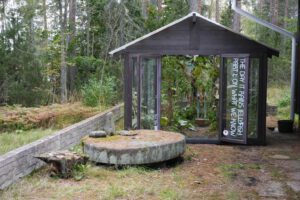
Location: Light-Harvesting Complex, Vantaa (FI)
READING
Myriam Gras, editor of the publication The Day It Rains Jellyfish, reads an extract from of the commissioned text from the publication called MEETING THE MONSTER AT EYE-LEVEL: On Dreams and Cosmopolitical Diplomacy by Erika Sprey, accompanied by her words on fields of plants, dreams and resilience, with input of the artists partaking in the exhibition series.
On fields of dreams, flowers and resillience
Myriam Gras
How should we re-member it, that is, put back together its different parts, reassemble it and reconstitute it as an integrated system in which humans and nonhumans, physical, chemical, and biological components, oceans, atmosphere and land-surface are all interlinked in a grand gesture of mutuality? – Achille Mbembe, Bodies as Borders
A few weeks ago, during the transition from summer to autumn, I travelled to the Scottish highlands to spend some time in the rust-red hills and mountains that seem to flow into each other like a giant braid. Together with my partner, who knows the stories and history that remain hidden to me, we decide to set up camp for the night in a place known as Deirdre’s Garden. As we wander along the banks of the sea loch next to it, characterised by soft, marshy grassy hills that merge with various types of seaweed and grasses so typical of these marshes that protect the land, he tells the story of Deirdre.
According to a legend in Irish mythology, there was a woman to whom it was prophesied before her birth that she would be so beautiful that much blood would be spilled over her and that it would lead to the splitting of the warriors of the Red Branch, legendary warriors of King Conchubar of Ulster. When the men hear this, they urged for the child to be killed, preventing her from fulfilling her destiny. Ulster, who wanted to have the reputation of a wise and a merciful king, decided to place Deirdre in seclusion until she was old enough to marry him and be put in such a high position that no man would dare to look at her. But fate intervened and Deirdre met Naoise, a Red Branch warrior at the king’s court. The couple instantly fell in love and fled to Scotland – cultivating a beautiful garden and orchard – where they lived happily for several years along with Naoise’s two other warrior brothers. Eventually they receive word that the king would allow them to return to Ulster but when they did so, they were betrayed and Naoise, along with his brothers, were killed and the distraught Deirdre took her own life. She was buried near to where Naoise and his brothers lay. The king however could not bear the thought of the two lovers touching one another, not even in death. And so he had wooden stakes driven into the ground, and in between their graves. But the wood grew roots and from the graves two trees grew entwined with one another.
After sunset, we leave the bothy or sheiling – a Gaelic word for hut – to gaze at the stars, as there is no light pollution in the sky above us. However, the stars are not the only source of light visible that night — looking towards the loch, we see a green-yellow light dancing in the distance. A will-o’-the-wisp. In folklore, this is an atmospheric ghost light seen by travellers at night, especially above bogs, marshes or swamps, which is said to guide or mislead travellers by resembling a flickering lantern. Will-o’-the-wisps are attributed to ghosts, fairies and elemental spirits intending to reveal a path or direction until they are noticed or followed, at which point they fade or disappear. Modern science explains the phenomenon perhaps due to bioluminescence or chemiluminescence. We can only dream of whether what we saw was the Will-o’-the-wisp or whether it was the result of our tired bodies drinking a few too many Bunnahabhains.
***
Now that I am back in Helsinki, I am surrounded by a pile of books, some of which contain dried bouquets of flowers, various notes, written contributions from artists for the programme Part I: On What We Know, and countless photos of flowers on my phone from places I have visited over the past few months. Some of the photos are from my parents’ garden. They have made it a habit to constantly search for unconventional plants that surprise them, turning a visit to the garden into a somewhat psychedelic journey. They always make sure to show me their latest acquisitions, the most recent of which have spiky bulbs. They tell me their scientific and common names, such as Cephalantus occidentalis, also known in Dutch as kogelbloem (bullet flower). My mother’s habit of identifying – and informing – is a habit she picked up from her grandmother, who taught her the Dutch as well as the Latin or Greek names of flowers during their walks as a child.
The leading classification system, known as binomial nomenclature, is based on giving two names and was developed by Swedish naturalist and botanist Carl Linnaeus in the 18th century. A plant is given a genus name and a species name. Linnaeus’ classification system was considered revolutionary because Linnaeus classified plants based on their reproductive system. In pursuing this goal, however, he continued a long-standing practice of assigning plants a gender and enshrined this practice in his classification system, so that science formally recognises plants only as male and female. Linnaeus’ system not only makes contemporary botanical language complicit in reinforcing the binary view of gender and sex, but it also confuses plant reproduction with that of humans. Its use fails to reflect the complexity and fluidity of plant sexual and asexual reproduction. For example, many forms of sexual plant reproduction require pollinators, while others clone themselves. Due to its popularity, the system gave way to a hierarchical classification into male and female in the naming of inhabitants of the animal kingdom and found its way into the exclusive formation of the notion of gender in our own social systems.
My phone also contains photos of hand-picked petals of blossoming peach flowers that influence the supply and demand and thus Spanish market prices, as well as Swedish arctic flowers picked by botanist researchers and growing in the melted glacier area (and for which permission was requested from the local Sapmi authorities). There are images of bouquets of flowers that hide cocaine within its stems, distributed through the extensive infrastructural network of the flower market, and experimental fruit tree varieties, grown by a friend in his garden in the Finnish metropolitan area. All this shows that simply growing or picking a flower, contrary to what was said in both the Victorian era and modern times, is not an act of delicacy and innocence, but an act of agency and politics.
***
From the wish to create a garden, I ask the artists in this exhibition to join me in creating one. This garden is not just to be any garden, an innocent garden, but one that is the result of labour and knowledge of old and new worlds: full of resilience and nutrients, dreams and magic. They chose a species that appealed to them; shared what they see when they look at them; what their associations are and what power emanates from them. We wonder whether it is possible to love flowers and be a dreaming revolutionary at the same time.
And so this process of designing a garden will not lead to a beautiful garden, but to a new, messier space; the result of reciprocity, alliances and conspiracies between plants and people. This garden would partly be fuelled by speculative qualities: sometimes the properties of the plant are used to heal and to undermine global capitalism from within, sometimes it is claimed that plants grow outside the logic of the capitalist system that exploits them. Let me describe this garden to you:
The garden lies beneath a number of large, graceful beech trees added by Renee Bus. These trees were once the tallest in the Dutch landscape. Their presence symbolises the sharing of (sacred) knowledge, learning and wisdom – stemming from their historical use for writing tablets and because they are the root of the word “book” in various languages. Not unimportantly, the beech also has many medicinal properties: its anti-inflammatory and antiseptic bark is used for lung conditions or various types of external wounds and skin conditions.
Anna Slama and Marek Delong have added a field of poppies around the trees. Of course we need poppies. These red flowers thrive in disturbed soil and help shape the landscape. Farmers often use them in crop rotation, but they have not escaped the attention of others either: they are known as a symbol of remembrance. It is said that poppies grow abundantly in places where soldiers have fallen, which can be traced back to the First World War and the Napoleonic Wars of the 19th century. More recently, the flowers, which feature all three colours of the Palestinian flag, have been widely used to support Palestinian resistance to Israeli occupation. It is fitting that their healing properties balance on the fine line between cure and toxicity, reflecting the delicate tension between care and danger.
Under the beech tree, Venus Jasper adds the oh-so-common plant Buckhorn, Ratamo in Finnish and Plantain in English. This plant also grows on disturbed soil and is one of the first medicinal plants they learned about. There is a broad-leaved and a tall-leaved variety, and it always grows right next to nettles (Nokkonen), like a kind of natural medicinal twin. Whenever you itch, the medicine grows right next to it, Venus tells me.
Plantain has a symbolic meaning related to steadfastness, endurance and protection. In German, the name of the plant suggests “ruler of the road”, which emphasises the association with finding one’s way and resilience. The plant has various medicinal properties; a syrup made from boiled leaves can be used as an expectorant for coughs. Freshly crushed leaves (using your teeth, fingers, a small pocket knife or a mortar and pestle) can relieve itching from nettles and mosquitoes and also promote wound healing – try it for yourself; the bleeding stops and the wound closes. In addition, the leaves have astringent properties, which can help reduce inflammation and fluid loss in skin conditions.
Kate Ruck chose nasturtiums for the garden. Nasturtiums are native to the Andes region of Peru and have a long history of cultivation and significance in indigenous agricultural practices. The plant has antibacterial and immune-supporting properties, edible leaves and flowers with a peppery taste that attract pollinators such as bees, and acts as a natural repellent against pests. The nasturtium is stubborn yet supple, bending towards others, offering protection without asking for anything in return and making room for other companions to thrive alongside it. This is a gesture that Kate recognises in her work entitled We learn the names of those we never knew (2024-ongoing), a way of remembering based on relationships and honouring what unfolds in the present. With the lingering fresh essence of nasturtium, a persistence endures. A persistence that outlasts the moment and draws us to something continuous and ancient. Such a presence compels a reconsideration of relation.
***
Classically speaking, the botanical sciences developed during the long eighteenth century functioned as a project for organising, visualising, labelling and classifying life. Although the past three centuries of scientific research have increased our knowledge of the physiology and biology of plants, it is difficult for us to experience plants as fully alive. While animals (including humans) are regularly portrayed by the moderns as creatures full of hidden worlds, plants do not seem to have an internalised subjectivity to compel us to imagine an ingeniously animated and animating matter that we can never perceive in all its operations.
Within this framework, the plant is able to unleash speculative energies to imagine the world and even participate in it in a different way than it presents itself to us. At the same time, plant life does not remain outside modernity or inherently opposed to the forces that structure it. Plants do not offer an escape from exploitation or a direct or problem-free outlet for utopian fantasies. Rather, they force us to face our own vulnerability in the face of ecological, social, political and intellectual changes, and often our deep, complex dependence on precisely those life forms that we are least inclined, or simply unable, to recognise. We need to learn to build and maintain our own fields of dreams.
***
[…] the 2024 publication Anthropology of the Dream State: Stories and Events from the Other World departs from the premise that “el estado onírico es un lugar donde algunos especialistas rituales en México aprenden su oficio, para construir e incidir en los diversos universos donde se encuentran el terrenal y el espiritual, pues muchos de estos personajes argumentan la existencia de múltiples cosmos, los cuales funcionan de manera análoga al mundo material”—that is to say that the dream state is a space where ritual specialists learn their craft, shaping and intervening across multiple universes, earthly and spiritual alike, which they describe to be coexisting in ways analogous to the material world.
These saberes (knowledges) are, by definition, practiced in the most intimate folds of community life, far away from official, standardizing institutional frameworks. The growing and renewed academic (and artistic!) recognition and interest presents both opportunities and risks in this regard. The West especially loves to turn inherently fluid, polysemic, and ephemeral relational practices—like dreaming—into tangible objects (“results”) that can be put on display, thereby transforming them into what we might call little monsters of their former selves. Isolated from their living contexts, despite best academic and curatorial intentions, they become more prone to calcify into mere ’tools’ and ‘methods’—rather un-vibrant artefacts severed from the hermeneutic circle of meaning-making that constitutes their cosmological horizon. It is precisely this lived totality of understanding that allows dreams to emerge as meaningful, collective, and cosmological phenomena rather than the nighttime neurological processing of an individual (the narrative most dominant in the West).
Therefore, we want the Dream School to be an unschooled, counter-institutional space for situated, open-ended, nonlinear learning from and within the dreamfield. What role, then, do we play, as visiting artistic researchers, when engaging with these dream practices and their territories, that are sometimes embedded within cosmovisions that are wildly divergent from our own? Philosopher Isabelle Stengers coined the term cosmopolitical diplomacy as part of her broader project of cosmopolitics, which asks how humans and nonhumans, sciences and other knowledge systems might co-compose a shared world without erasing differences — meeting other worlds on their own terms, at eye level. How do we bring this form of diplomacy into practice?
This cosmopolitical vision finds powerful resonance in one of the most recognized expressions of Zapatista: “Es necesario hacer un mundo nuevo. Un mundo donde quepan muchos mundos, donde quepan todos los mundos” (“It is necessary to make a new world. A world where many worlds fit, where all worlds fit”). Meeting each other at eye level means, above all, to neither gaze upward nor looking down upon—especially when the going gets tough. These gestures would truncate the bond of reciprocity, establish conditions for power imbalance, and reinforce a form of (neo)colonial, extractive relation that seeks to engage only with the acceptable and profitable aspects, while dismissing the ‘difficult’ dimensions of another’s cosmogony as mere ‘folklore’ and ‘superstition’.
Cosmopolitical diplomacy, we soon realize, requires above all that we turn the gaze within: how do we show up in these oneiric encounters and speak from our own particular situatedness–that complex assemblage of ancestries, lineages, conditionings, and worldings that constitute ‘we’? Instead of making ourselves ‘transparent’ – let’s not fall into that trap – how can we at least make ourselves ‘localizable’ to the peoples, entities, and landscapes we encounter along the way in our walking, waking and dreaming?
[…]
“To control the dream experience is to control transformation and to know how to navigate the relationship with alterity. The goal is to avoid complete transformation, the total loss of the soul; yet partial transformations or multiplications of the self are sought. One trains the capacity to be simultaneously here and there—in the ‘other world’ and in this one—sending a soul into the realm of otherness without surrendering the whole person. These abilities make possible what has been called ‘cosmopolitical diplomacy’ and constitute a profound source of power.”
To face the monster in the dreamfield, eye to eye, is never for the faint of heart. It all comes down to the intention with which one cultivates this “profound source of power.” For there is a fine line between the brujo or the bruja—the many-gendered witch who bends this gift toward selfish designs, para hacer el mal (to do evil)—and the curandero or curandera, who takes up the same power for healing and as a form of diplomacy: negotiating with the unseen and restoring cosmic balance and health, working in the service of both human and more-than-human communities. This dream craft extends even further, reaching towards the larger cosmos and, ultimately, to the planet itself.
This last section is an excerpt of the essay MEETING THE MONSTER AT EYE-LEVEL: On Dreams and Cosmopolitical Diplomacy by Erika Sprey, commissioned for Text my Sister’s publication The Day It Rains Jellyfish, 2025. Publication available upon request.
See Next