
Armour of Transience
by Maite Breurkens
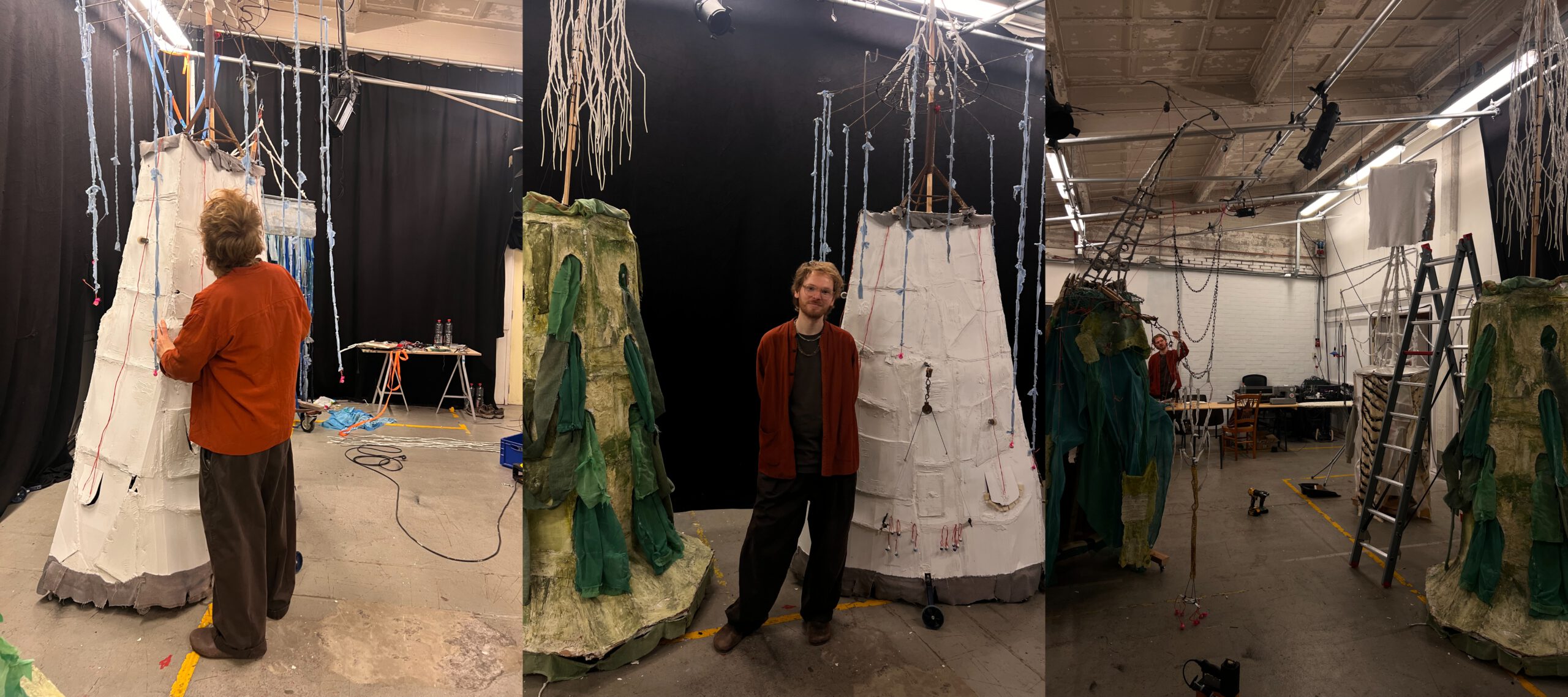
Pieces of cardboard, ropes, shreds of textiles and wool are scattered all around. Somewhere, a bit hidden in all these materials, someone is kneading clay onto a wire rope. The space feels and looks alive, just like the impressive sculptures you find standing in the room, waiting to be finished. In the midst of all this vibrancy, you find Wessel Verrijt working on his solo exhibition: This Being a Temporary Structure, which is now on view at PARK until the 13th of December.
Upon entering the space, you’re teleported to a world of mythological creatures, carnival parades, altars, deities and anything in between: the sculptures resist being placed within a single frame of reference. While one element reminds you of something otherworldly and ancient, another might look like something from your childhood. A small trolley wheel is recognisable and a tablecloth that may have been part of someone’s Christmas dinner at some point. The harder you try to define what you’re seeing, the more difficult it becomes. The sculptures invite the imagination to wander, drawing on familiarities while keeping their own identities just out of reach.
Fragments of earlier sculptures may be recognisable for those who are familiar with Verrijt’s work. After each exhibition, he takes apart his sculptures and uses their remains to create new work. Their forms are never really finished, and their existence does not end with the exhibition. Once they have seen the light of day they might be taken apart again. Their parts may become something else, carrying with them traces of what they once were, evolving. Reminding us of the transience of life.
The reminiscence of previous sculptures are combined with other materials, from debris to household objects, he transforms his surroundings into new forms, redefining their original functions. As Verrijt’s practice changes and grows, so do his sculptures. They are, quite literally, evolving with the artist. This method of work is not something unique to Verrijt’s artistic practice. In fact, in his approach he found similarities to ‘The Garbage Bug’. The larva of the green lacewing covers itself with fragments of its surroundings, collecting debris and other small materials, similar to the way in which Verrijt gathers, stacks and composes materials in his work. The bug uses it as a protective layer that camouflages them from predators. What might otherwise be considered waste becomes armour. An armour of transience, built from materials that, in human eyes, no longer serve a purpose.
Verrijt’s sculptures seem to do something similar. Textiles, wood, household objects and other discarded materials are assembled until their original identities and functions begin to blur. The entities appear to wear their surroundings, almost like a costume, carrying fragments of the outside world as their armour. By reusing parts of his sculptures and transforming them into new work, Verrijt prolongs the life of what we have written off.
This relationship between body and material extends into performance. Verrijt merges sculpture with movement, creating what he calls “hybrid entities”, in which bodies and objects fuse and materials become active participants. He places performers in his sculptures, who are wearing them like costumes (developed in a collaboration with Celine Caly) allowing them to move around during the performance. Similar to the bug, they’re using the costume as an armour to explore their surroundings in slow and repetitive movements.
By adding humans to his sculptures, Verrijt plays on the boundary between what we consider to be alive or dead. In our current society, we tend to think of the two as separate states. Verrijt’s sculptures suggest something less definitive, influenced by the way that humans viewed nature and death thousands of years ago. Objects are dismantled, fragments of previous sculptures are preserved, and discarded materials are given new forms. What has seemingly reached its end becomes part of something else. Instead of dying, the materials continue their existence, carrying traces of its previous life into its next form.
Reference:
Zawislak, Jon, Austin Jones, and Whitney Haigwood. “What’s That Bug? – Green Lacewing Larvae.” Agriculture and Natural Resources Blog, University of Arkansas System, Division of Agriculture. https://www.uaex.uada.edu/environment-nature/anr-blog/posts/whats-that-bug-green-lacewing-larvae.aspx